Freezing wind sweeps across the tundra, ceaselessly battering anything that dares to grow or breathe in its domain. Even in summer, when the days stretch interminably long, the sun blazing low in the midnight sky brings no respite from the chill. Without fail, the wind finds its way through every chink and crack, every opening in the warmest furs, every tent flap, every roof and board of the strongest homes. It drains away any hint of warmth wherever it finds purchase.
The threat of winter’s fury is never far away. The wind sweeping down from the Reghed Glacier howls its wrath and sometimes carries stinging sprays of ice in its grasp. The sun never rises far above the horizon even at the height of summer—and the height of summer is fleeting. During the rest of the year. sudden storms bring driving hail or sleet that leaves everything coated in a sheath of ice, or they bring snow that piles in deep drifts.
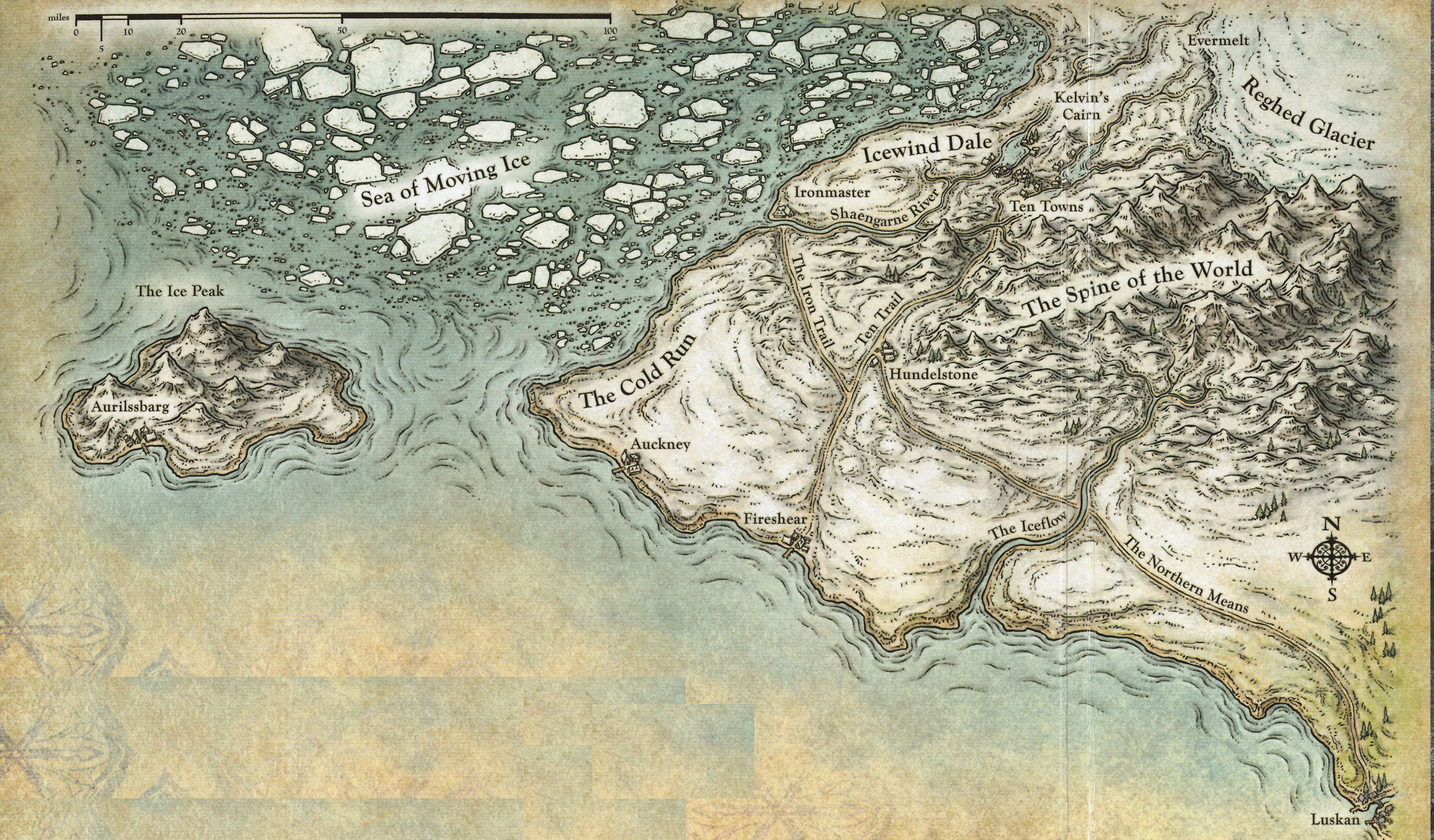
All this cold and fury is caged into one small region. The ice cliffs of the Reghed Glacier—the source of the never-ending wind—rise up in the east like prison walls, home to white dragons and enormous remorhazes. In the south loom the snowcapped peaks of the Spine of the World, crawling with orcs, goblins, and other monsters. North and west, the Sea of Moving Ice churns bergs and floes in an endless tumult, like winter grinding its teeth in anticipation of its next freezing assault.
And yet, such is the nature of life that even in this hostile place, it manages to lift its head in defiance of the biting cold. Lichens cling to weathered rock despite the battering of the winds, providing sustenance to herds of reindeer through the winter. Fish swim in the lakes and rivers that dot the tundra.
When summer comes to the tundra, life shakes off the torpor of winter and comes forth in full flower. Grasses grow two or three feet high in the span of weeks. Birds flock to the marshes formed in the thawing soil. Reindeer calves fill out the herds that have been diminished through the winter.
Of course, no region of the Forgotten Realms is without its people. Human tribes follow the reindeer herds through their annual migrations. Other humans dare the treacherous waters of the Sea of Moving Ice in search offish, seals, and whales to sustain them. Dwarves dig into the earth to find shelter from the biting wind, mining for iron and forging weapons and armor.
Most improbably of all, civilized folk descended from foolhardy and treasure-mad immigrants from the south manage to survive and sometimes thrive in ten small towns. The wooden buildings of these towns provide only a little shelter from the cold and wind, and no protection at all from the attacks of orcs, barbarians, or the fierce tundra yeti. Though the towns are clustered around three icy lakes teeming with knucklehead trout, resources are scarce, and competition between neighboring communities can be fierce and occasionally deadly. But for all the dangers, people still live in the region known as Ten-Towns, and new arrivals—outcasts, fugitives, wanderers, and adventurers—still come to test themselves against the harshest environment known to the world.
This is Icewind Dale.
Life in Icewind Dale
Icewind Dale is a harsh and unforgiving landscape. It is the very edge of the explored world, the last stop for travelers and civilized society. The vast open tundra, bordered by the Reghed Glacier on the east and the Sea of Moving Ice to the west, is buffeted by heavy winds thick with snow. War is common, both inside and against the cities. With wood, meat, and plants all in short supply, Icewind Dale is a difficult environment in which to survive. Nevertheless, people persevere.
At the edge of The Spine of the World mountain range, Icewind Dale is rocky and rich with minerals. A single mountain, Kelvin’s Cairn, stands alone near the center of the Dale, its waters feeding three massive lakes: Redwaters, Lac Dinneshere, and Maer Dualdon. Around these lakes, the community known as Ten-Towns has formed to reap the benefits of the knucklehead trout that flourish there. Most towns in Icewind Dale rely on trade with the southern cities of the Sword Coast to get by.
While humanoid life may struggle in Icewind Dale, other forms of life thrive. White dragons are common amid the mountains, and violent spirits and gods often wreak destruction. But on a clear night, the sky is full of stars intertwined with auroras. Many of Icewind Dale’s inhabitants consider the region to be beautiful once you overcome its challenges. It is a place where a person is tested, but also where a person may be free to live as themselves.